
It's the week before a big investor visit. You open the company team page and it's a state. Twelve different selfies, a couple of cropped wedding photos, and at least one headshot that was very obviously taken in a car. Sound familiar?
If you're the person who has to sort it, usually someone in HR, marketing or office management, the hard part was never the photography. It's the logistics. How do you get 40, 60, a hundred busy people photographed to the same professional standard without writing off a working day?
For most London companies the answer has become refreshingly simple. Don't send your team across London to a studio. Have the studio come to you.
That, in a line, is on-location corporate headshots. And the choice behind it is more practical than "studio quality versus not". A good corporate headshot photographer brings the studio with them, so the real question is simple: does your team travel to the camera, or does the camera come to them?
First, what "on-location" actually means
There's a myth that on-location means someone snapping your team against a magnolia wall with a phone. It doesn't.
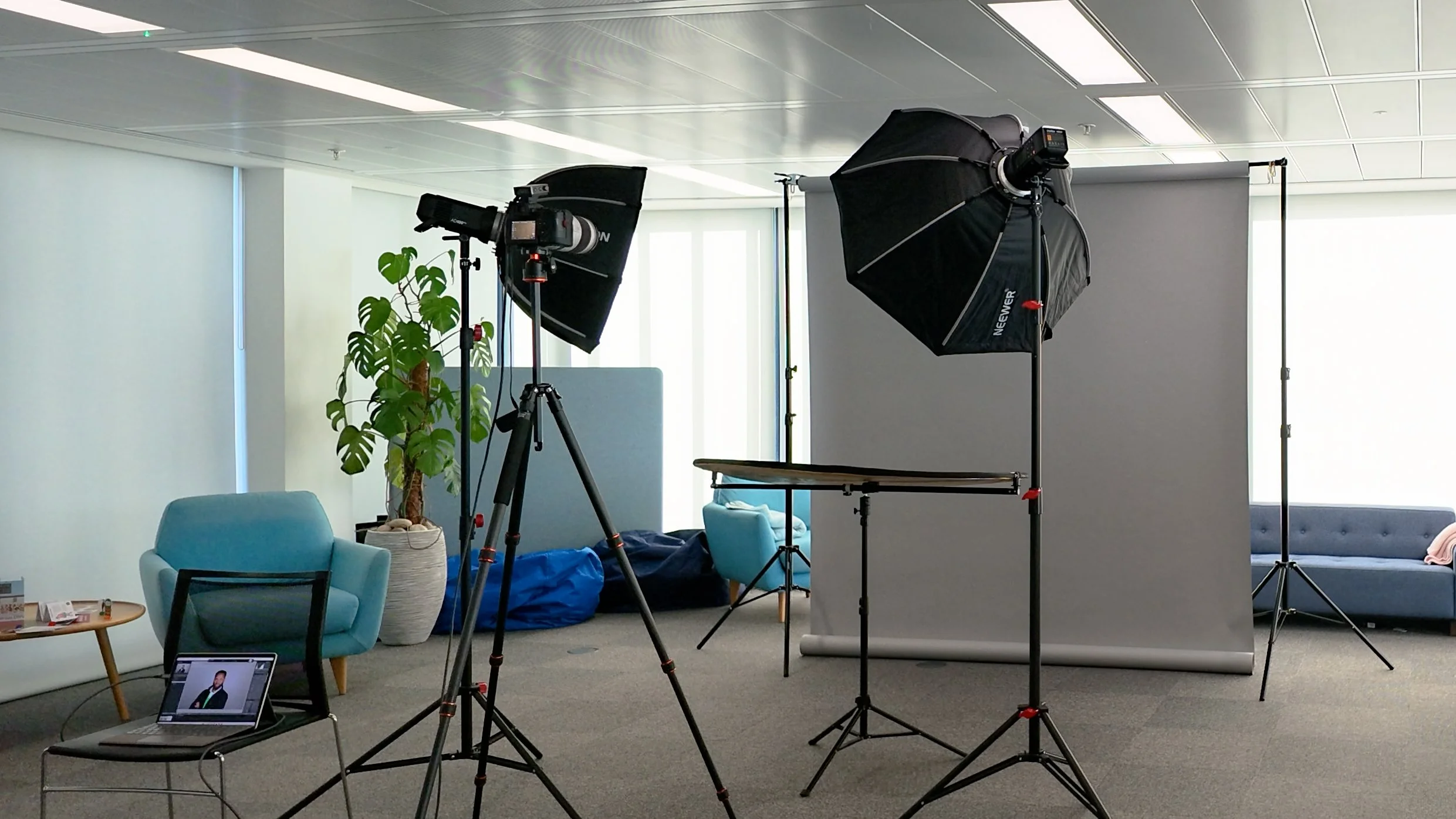
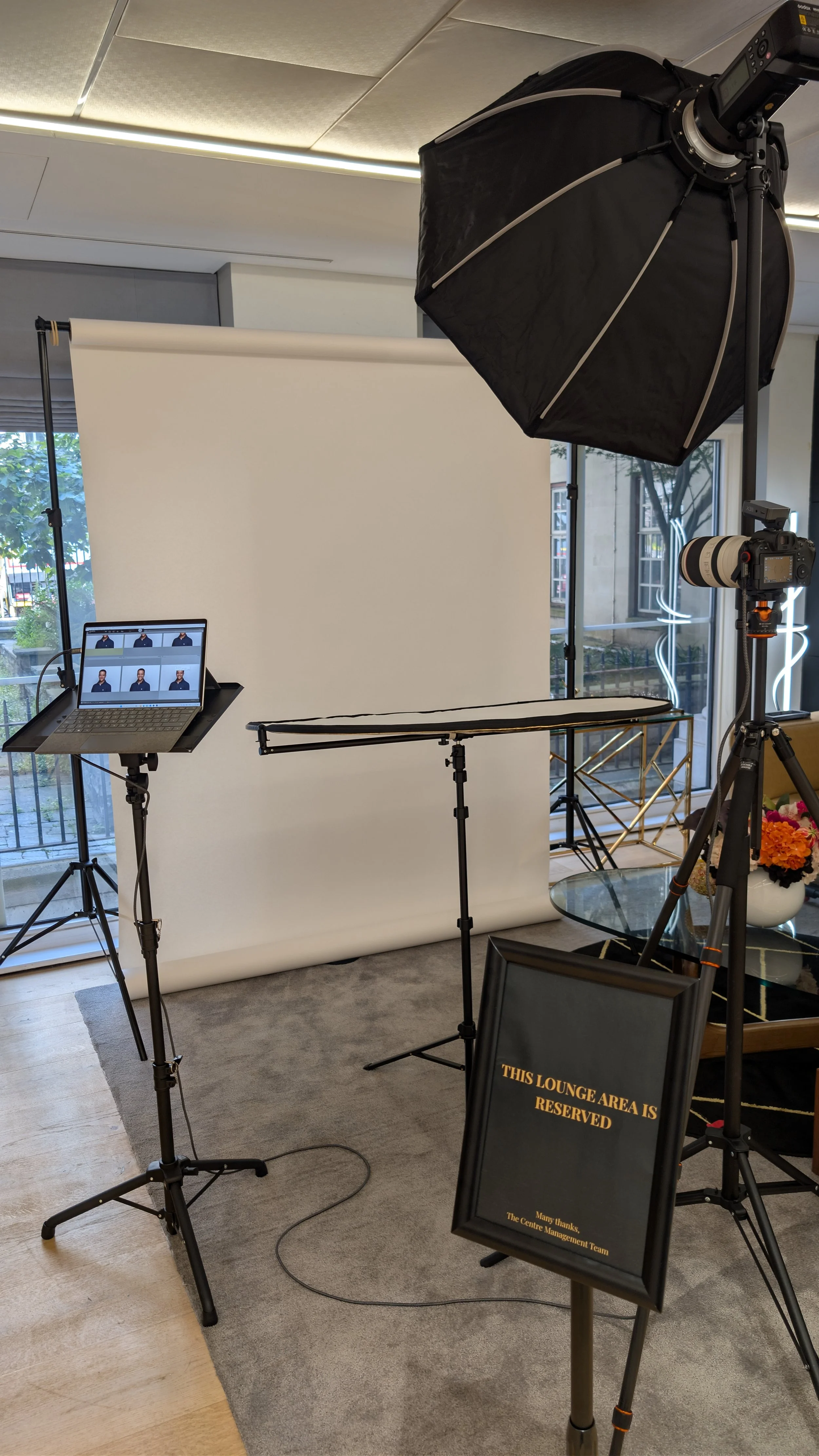
It means I bring a full portable studio to your office. Professional lighting, a proper backdrop, a laptop so we can check shots as we go, all set up in whatever space you have. A meeting room. A quiet corner. Reception, if that works best.
The result is identical to a purpose-built studio, because what makes a headshot is the equipment and the lighting. The room is just the venue. A tidy corner of your boardroom and a fancy space in Soho produce the same photo. The only thing that changes is who packed a bag and travelled. I use the exact setup I'd use in a studio. I just bring it to you.
Why so many teams have the photographer come to them
It comes down to four things: the journey, the time it eats up, people's nerves, and how many of them actually show up.
Nobody arrives flustered
Send 60 people to a studio and you've created 60 separate journeys across London. Delays, drizzle, a signal failure at Bank, someone turning up sweaty and rattled two minutes before their slot. The camera catches all of it.
And there's solid research behind this. A University of the West of England study that followed more than 26,000 UK workers, using the long-running Understanding Society survey, found that longer commuting lowers job satisfaction and worsens mental wellbeing. An extra 20 minutes of daily travel dented people's job satisfaction about as much as a 19% pay cut. Picture that stress landing on someone right before you point a camera at them.
Bring the shoot to the office and the journey disappears. People step out of a meeting, sit down composed, and are back at their desk a few minutes later.
People relax more in their own environment, and it shows
We judge a face astonishingly fast. Princeton researchers Willis and Todorov put it at about 100 milliseconds, a tenth of a second, to form a first impression of trustworthiness and competence. Tension reads instantly. So a calm subject photographs as more approachable and more credible.
Familiar surroundings do a lot of that work for you. Put someone in a strange studio and there's a low hum of wariness: shoulders up, jaw tight. Their own office doesn't do that to them.
The rest is my job. I spent years in customer service and if it teaches you anything, it's how to make people feel at ease. My family have always called me the calm one, the one people feel safe around, and that turns out to be most of the work. Relaxed people take better photos. Every time. No forced smiles, no awkward angles.
Fifteen minutes each, then back to work
On location, each person needs about 10 to 15 minutes and then they're back at their desk. A studio round trip can swallow half a day per head once you count getting there and back. Multiply that across a team and it's a real productivity hit, plus a lot of broken concentration for something that ought to be painless.
Everyone actually shows up
This is the one HR feels most. Travel friction is where participation falls apart. "I couldn't get across town." "I'll catch the next one." Before long your shiny new directory is two-thirds finished and stuck.
Take away the journey and turnout climbs. You photograph the whole team on the day, which is the difference between a harmonised set of staff headshots and a patchy one. A complete, consistent team page is what "investor-ready" actually looks like.
There's a nice bonus, too. When the company absorbs the logistics instead of sending people off on their own time, it lands as a small act of looking after the team. Never a bad message to send.
Want to see how this would work for your team? Learn more about on-site corporate headshots in London.
"Will it look as good as a real studio?"
Yes, because it is one. It's the same professional equipment, lighting, backdrop and editing I'd use in any studio, and all of it travels with me. Where you sit for it makes no difference to the photo that comes out.
Consistency across a big team comes down to process. Identical lighting and backdrop for every person gives you a directory where everyone lines up, whether they were shot in your boardroom or a broom cupboard. Which brings me to a story.
We can make almost any space work (and I mean almost any)
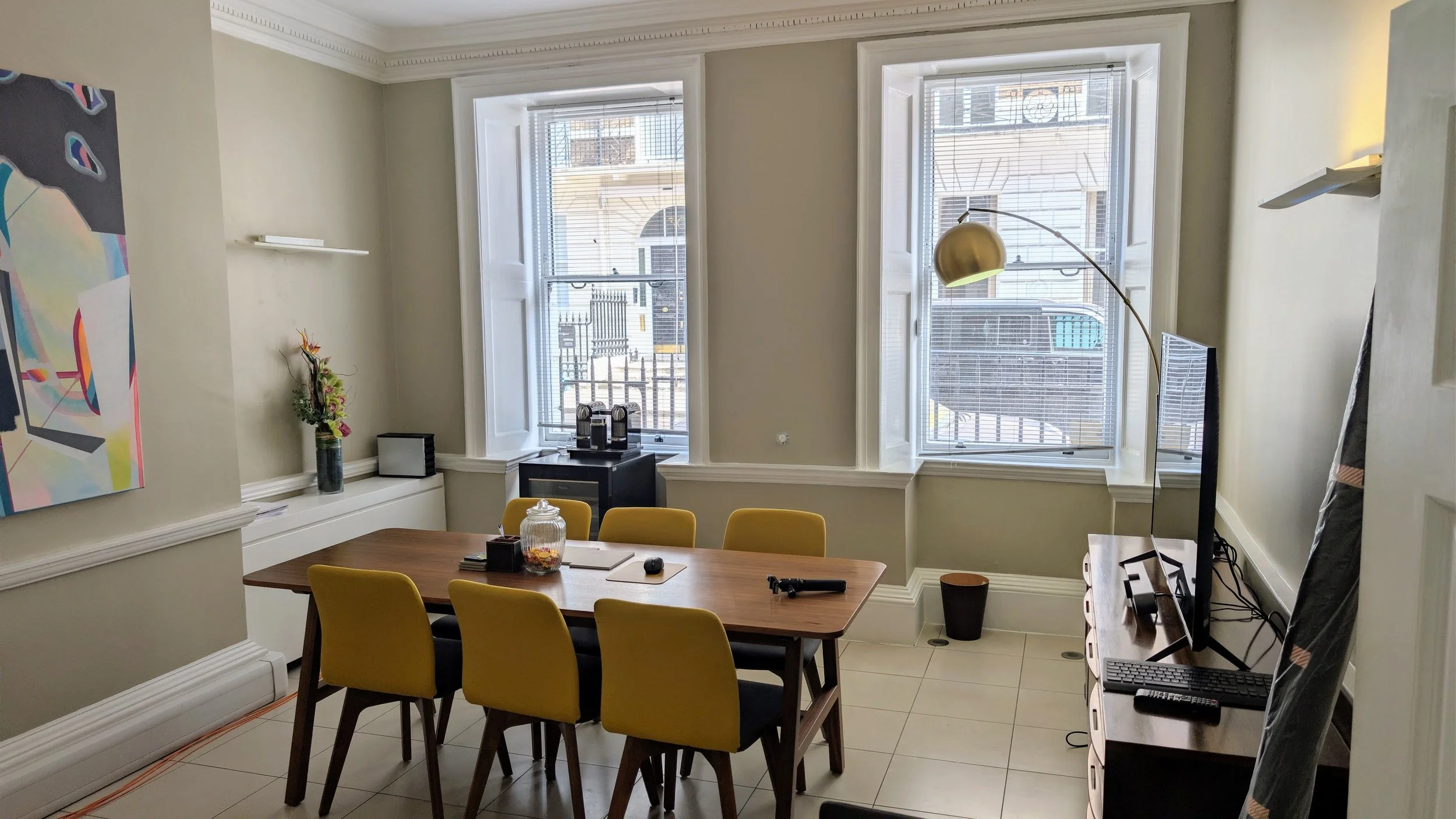
My ideal is roughly three metres by three. That's a comfortable amount of room. But "ideal" and "required" are very different words, and I've learned to work with a lot less.
For exampleA while back a London team booked me because their US parent company had a gorgeous set of headshots, every member of staff photographed against the New York skyline, and they wanted a London version to match. Lovely brief. One snag: when I arrived, their side of the building didn't show London off at all. Every landmark worth having, the stuff that actually says "London", sat on the far side of the floor, which they couldn't get into.
So I scouted the office. The best view in the building turned out to be a stairwell. I asked reception if I could set up there briefly to catch the skyline, and they kindly said yes. I took the portable equipment and built a tiny studio in a space barely a metre square. They wanted tight headshots, so I knew it would work, and the results came out brilliantly. The client was thrilled, and their London team finally matched head office.
The stairwell is just one example. A full professional setup is portable, and I'm happy to problem-solve, so I can get the shot in almost any building. Give me a corner and permission to shift a couple of chairs and we're away.
When it makes more sense for you to come to me
I'd rather be upfront about when on-location isn't the right call. It builds more trust than pretending it always is. Coming to a studio, or a hired central space, usually wins in three situations, and none of them are about backgrounds.
The first is when you don't have a suitable space. If you're home-based, between offices, or your workspace has nowhere sensible to set up, a studio session is cleaner.
The second is when it's just one or two people. A single new director or a mid-quarter starter doesn't warrant a full on-site visit, and it's quicker for them to pop into a studio session and be done.
The third is when your team is fully remote or scattered, with no central office to gather in. Then we look at a pop-up day, everyone to one central London spot on a single date, or individual studio sessions, with new joiners photographed on a rolling basis so they always match.
Often the smartest answer is a mix. On-location for the bulk of the team, studio sessions to mop up the solo execs and stragglers.
How a session with me actually runs
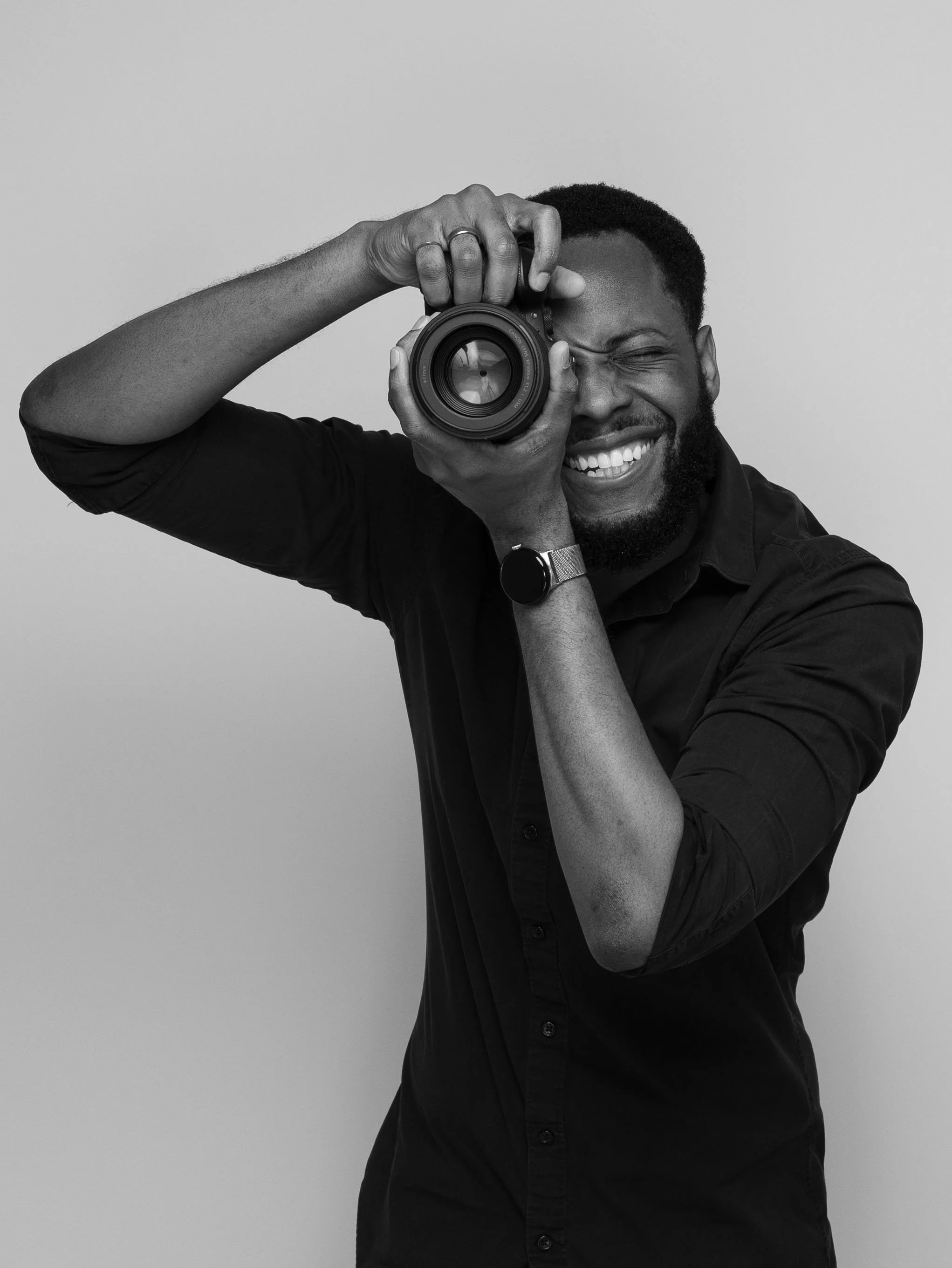
As a London corporate headshot photographer, I've tried to make the whole thing as light-touch for you as possible.
We start by talking through your space, what you've got and how we'll make it work. A few photos of the likely spots usually tell me everything, or we jump on a quick video call and scout it together.
On my Scale-Up packages and above, I handle the scheduling for you. I set up a simple booking page where your people choose their own slots, spaced so everyone has time to come and go without a queue ever forming. No spreadsheets, no chasing anyone down the corridor.
On the day we work through the rotation, and everyone reviews their shots on the spot. They pick their favourite there and then, which kills the endless "which one do I use?" email thread. Afterwards I retouch and deliver in the formats you actually need: LinkedIn-square, web-directory crops and print-ready files.
A few practical things HR and office managers tend to ask about, all covered:
I carry public liability insurance, so having me set up on your premises is no drama.
I'm happy to work around NDAs and secure areas. If there are sensitive floors or screens you'd rather keep off-camera, brief me and we'll plan around it.
Pricing is a fixed with a clear quote up front and proper corporate invoicing, so procurement gets exactly what it needs.
Turnaround is fast. You'll see the images on the day, and edited files follow shortly after.
Sorted on the details? Book your next headshot session.
On-location vs travelling to a studio, at a glance
Look at the quality row. It's a tie on purpose, and that's the whole point
| Photographer comes to you | Your team travels to a studio | |
|---|---|---|
| Travel & hassle | None. I come to you | 60 separate journeys across London |
| How people arrive | Calm, straight from their desk | Often late, rushed, flustered |
| Disruption to the day | Minimal (~10–15 min each) | Half a day per person, with travel |
| Turnout / completion | High. No travel excuse | Lower. Journeys lose people |
| Photo quality | Full portable studio, same professional equipment | Same professional equipment |
| Best for | Whole teams in one office | No office, single people, remote teams |
Quality's a wash, so it really comes down to who travels. And for most teams, the answer is "please, not all 60 of us."
Frequently asked questions
Do on-location headshots look as good as studio ones?
Yes. It's the same portable studio, lighting and backdrop I'd use anywhere, set up in your space. The equipment and lighting decide how a headshot looks, and those come with me.
How much space do you need?
Around three metres square is ideal, though I've built a working studio in a space barely a metre wide. Give me a corner and I'll make it work.
How long does each person take?
About 10 to 15 minutes, then they're back at their desk.
Will it disrupt our workday?
Barely. People drop into short slots and rotate through, and most are back at work before their coffee's gone cold.
Can you photograph just one person, or a remote team?
Absolutely. Solo directors and new starters suit a studio session, and for remote teams I run pop-up days or rolling individual sessions so everyone still matches.
Do you travel across London?
I do. I work with teams right across the City, Marylebone, Mayfair, Fitzrovia, Wimbledon, Clapham, Putney, Wandsworth and beyond.
Do you provide a quote and corporate invoicing?
Yes. A clear, fixed per-head quote up front and proper corporate invoicing for your finance team.
How do you keep a big team's headshots consistent?
Same setup, backdrop, lighting and editing for everyone, so the whole directory lines up.
Ready to plan your team's headshots?
If your team page needs to look consistent and properly professional, without pulling everyone out of the office for half a day, on-location is almost certainly your easiest win.
Tell me roughly how many people, where you're based, and when you're hoping to do it, and I'll take it from there. Ready to plan your team's headshots? Let's chat.
